GOLF'S BIRTH
by: David Brown
Born, cradled, and nurtured on the wild coasts of Scotland, golf is native to the British Isles and an exotic plant everywhere else -- although, like many exotics, it has often found conditions even more to its liking where it has been imported. Scotland's pride are the natural links where time and the seasons were the principal architects of courses like Royal Dornoch, that noble links of the north, and the austere, patriarchal St. Andrews, the shrine to which the greatest still return to pay homage. Golf began its travels when it was taken south to England by the Stuarts and then to the four corners of the earth by the men of both nations in the Empire-building days of the nineteenth century. Progress was tardy on the European mainland, where even now clubs number only a third of the 2,000 or so that thrive in Britain. Among the earliest of courses on the Continent of Europe were those built during Queen Victoria's reign at watering places to which the wealthy British migrated annually to take the cure; spas like Baden-Baden in Germany, Karlovy Vary and Marienbad in Czechsolovakia (then a realm of the Hapsburgs), and Pau, in the foothills of the Pyrenees, the earliest of them all (1856). Most progress, outside Britain, has been made in northern Europe -- the Low Countries (where there are echoes of Scottish linksland), Sweden and Germany, which each have more than a hundred courses. Changing patterns of wealth and tourism have seen the emergence recently of new seaside courses like Vilamoura and Sotogrande at Europe's other extreme, the Mediterranean and Atlantic coastlines of the Iberian Peninsula. Similar in appearance and atmosphere to the resort courses of North America, they have been built as commercial developments by entrepreneurs and have had the benefit of some of the best architects that money can buy. Their sunlit, Sybaritic ambience seems a world away from the windswept linksland of the Scottish coast where the game took root, almost organically, as part of the life of small, tightly knit communities.
THE OLD COURSE -- ST. ANDREWS
Nature fashions an ageless masterpiece
For centuries, the eyes and thoughts of golfers everywhere have turned towards St. Andrews; in all their world there is nothing to compare with the ancient university city and the Old course spreading away from its doors. Here is the very heart of golf, the very breath of its history on links that, for countless ages, have known so little change. Every golfer there ever was has wanted to play at St. Andrews, and down the years it has attracted more pilgrims than any other course in the world.
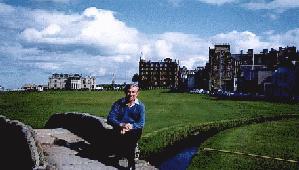
At first sight, the Old course may not seem remarkable. One will have been charmed by the intimacy of its approaches from within the city and the beauty of the spacious rectangle of green, sweeping down from the Royal and Ancient clubhouse, grey, four-square and slightly forbidding. On one side are the smaller clubs, Old Tom Morris' shop, hotels and houses; on the other a rolling sward of putting green, and beyond, the superb bay, leagues and leagues of golden sand curving away toward the distant estuary of the Tay. The Old links has been condemned as an anachronism and cursed as being unfair, but no course has commanded greater affection and respect from those who have learned to appreciate its subtleties and charms. It can be as tantalizing as a beautiful woman, whose smile at once is a temptation and a snare, concealing heartbreak and frustration for some; joy and fulfillment for others, but possession only for the very fortunate few. It does not yield its ancient secrets lightly or take kindly to contempt and impatience, but it does reward those who give their best in thought, temper and technique.
Furthermore, St. Andrews is the setting for the Royal and Ancient Club. It was founded on May 14, 1754, when twenty-two "Noblemen and Gentlemen" being admirers of the ancient and healthful exercise of the Golf" met to subscribe for a silver club, to be the trophy of an annual competition. Since then its sphere of influence has become almost universal, except in the United States, which has its own governing body in the USGA.
There is no telling when golf began at St. Andrews, but the earliest written evidence was a license, issued in 1552, which permitted the community to rear rabbits on the links, and "play at golf, futball, schuteing ... with all other manner of pastimes". The proprietor was bound "not to plough up any part of said golf links in all time coming" but to reserve them for the comfort and amusement of the inhabitants. So, for more than 400 years, every golfer has enjoyed a right to play over the course, and only within the present century has a modest green fee been imposed. The Old course remains a monument to the origins of golf as a game played on links by the sea. In the beginning it knew no architect but nature; it came into being by evolution rather than design; and on no other course is the hand of man less evident.
In all the years since the Royal and Ancient Club was formed, the outline of the course has never changed. It was then no more than 40 yards wide, a rolling strip of linksland between the gorse bushes in the shape of a huge billhook. There was not room for separate holes going out and home, so the golfers played eleven (later nine), out to a distant turn by the shining waters of the Eden estuary, and returned using the same fairways and greens.
St. Andrews must have had its perilous moments in those days -- and it still can, for seven of the double greens remain -- but nowadays there is more delay than danger on a crowded day. The double greens are so huge that only an extremely wayward shot will find its way on to another man's province. If so, the player can face a length of putt undreamed of on any other course in the world. Nowhere does the old excuse for an indifferent score of taking three putts hold less water. The man in search of sympathy for such failings is an optimist; he is saying, in effect, that his golf through the green was prodigal in its length and direction.
The greens are further evidence of nature's bounty; most of them are on plateaus, sometimes only slightly raised above the level of their surrounds but plateaus nonetheless. When the wind stands firm and the turf is hard and swift, the man who pitches to the hole can be lost; the pitch and run or the plain running approach must be used, though such conditions nowadays are the exception rather than the rule at St. Andrews. In common with many other links it has lost something of its seaside character; the grass on the fairways is richer, the greens more holding than of old. Often enough, it is possible to pitch to them and low scoring is easier in consequence. When the Open was there in 1964, Nicklaus played the course twice on the final day in 134 strokes yet still gained only four on Tony Lema, who won the contest with commanding ease.
Another remarkable feature of the course is the multitude of bunkers, most of which are named, ranging from vast sandy caverns to little holes of varying depth often allowing room only for an "angry man and his niblick". All are natural, many are relics of the days when people dug for shells deposited by the sea before the links were formed, while others were made by sheep sheltering from the wind. Over the years great numbers were filled, but enough remain to test and infuriate the mightiest, because they are not always visible and seem to lurk in the most unexpected places.
Lying within the curve of a bay on the northeastern shores of Fife, the course is vulnerable to every caprice of the wind. Many are those who have played to the turn against it and then hoping for assistance on the homeward journey, had to face it all the way back. The strategy of play can change within the hour. Such are the whereabouts of the hazards that the slightest variations in the wind can mean the difference between being trapped in an infuriating little bunker and having a straightforward shot to the green. There is no standard way of playing the holes, except for the first and the last. Everything depends on the wind; an approach may be a brassie one day, a short pitch the next. Because of this, no distances are given on the tees, a fact that visitors, particularly Americans, may find disturbing. But the information anyway would be of little use to them.
The Old course makes a wonderful play on courage and fear, but above all, it is an examination of a golfer's thinking; he can never relax. In view of this, it is not surprising that nearly all the great golfers throughout the ages have grown to respect the place, and some, like Bobby Jones, to love it. With Jones, it was not love at first sight. In the third round of the 1921 Open, he was a dozen or more strokes over par and after taking six on the sort 11th, tore up his card. The world knows how he redeemed that failure with a famous victory six years later, and another in the Amateur Championship, the first stage of the "Grand Slam" in his imperishable summer of 1930.
When, almost thirty years later, Jones was given the freedom of St. Andrews and made an Honorary Burgess of the city -- a distinction not conferred upon an American since Benjamin Franklin -- he said, "The more I studied the Old course, the more I loved it and the more I loved it, the more I studied it, so that I came to feel that it was for me the most favourable meeting ground possible for an important contest. I felt that my knowledge of the course enabled me to play it with patience and restraint until she might exact her toll from my adversary, who might treat her with less respect and understanding".
The beginning of the course seems innocence itself. The widest fairway in existence -- shared by the first and last holes -- looking inviting, but at its limit winds the Swilcan Burn, an immediate menace to peace of mind for it must be carried by the shot to the 1st green, and this invariably is longer than it looks. From the second tee the long trail outward begins down the narrow ribbon, perhaps a hundred yards across, of crumpled, saffron links, broken only by the emerald pools of the double greens and the countless folds, falls and hammocks of the ageless land. This second hole is a perfect example of the course at its best, especially when the flag is toward the left of the green. The only reasonable approach is from the right, so either the drive risks bunkers and gorse or the second shot must be played to the right-hand part of the green, leaving a long and formidable putt.
The problem at the third is the same -- a measure or risk must be taken from the tee for clear pitch to the pin; likewise at the fourth, with its drive along a valley between a plateau and the inevitable gorse and bunkers on the right. A host of bunkers await the drive to the fifth which is aimed too straight at the distant pin; this is the Hole o' Cross, 564 yards long, which forces a decision whether to attempt to carry a hill with two large bunkers in its face or play short, leaving a longish third to the green. In the 1933 Open, with the ground bone-hard and a gale behind him, Craig Wood drove into one of these bunkers, almost a quarter of a mile from the tee. A slight ridge protects the sixth green and makes the approach seem shorter than it is, a common feature of the Old course. The stranger is forever underclubbing.
The next six holes form what is commonly known as the Loop, where the foundation of low scores invariably is made; on occasion they have been played in eighteen strokes or less. The drive to the seventh is one of the most testing -- practically blind, with a sea of gorse to punish the slice -- but the eighth is not a severe short hole. Good drives make threes readily possible at the next two holes, but the little approach to the ninth is dead flat. It has caught many a player in two minds as to whether to pitch or run it, and has often resulted in a scuffle.
Of all the great short holes, the eleventh stands high. The green is on a considerable slope, with the waters of Eden beyond; to the left is the deep Hill bunker. The essence of the shot is to avoid these and yet not to have a fiendishly difficult putt. To finish above the hole with the wind off the estuary is to invite three putts; men have been known to putt off the green. Gene Sarazen once took six there, with three shots in the Hill bunker, and eventually lost the championship by one stroke.
There never was a hole more obviously the work of the Devil than the twelfth, where seeming innocence conceals all manner of evil. However well one knows the hole, it is hard to realize that so much danger exists between tee and green, only some 300 yards away. None of it is visible, but the fairway, a gentle green slope, is infested with bunkers.
After the thirteenth, with its second over broken, heathery hills, the task is stern indeed. No single hole in golf has brought more championship competitors to grief than the fourteenth; the number of great golfers who have taken sevens and worse there is legion. In any kind of wind, save a helping one, the prospect from the back tee is fearsome indeed, with the five Beardies bunkers clustered together to trap the slightest pull and a low greystone wall jutting into the line from the right. Only the bold or the very strong attempt to carry the great Hell bunker and its attendants, and then remains the problem of judging the third shot over a sleek, steep bank. The fifteen presents no great difficulty apart from the wretched little Sutherland bunker, precisely on the cautious line from the tee. Long ago, the Green Committee ordered its removal, but rebels went in the night, opened it again and there it remains.
The confident or the unthinking will drive between the railway and the Principal's Nose bunker, a threateningly narrow approach to the sixteenth. The railway, whose fences remain, is nowadays out-of-bounds. But in olden days, when it was a cart track, golfers carried a track iron, one of which can be seen in the royal and Ancient Museum. The prudent line from the tee is to the left, but the Wig bunker by the green must be avoided. Then at last the golfer stands on the tee of the most famous hole in the world.
The drive over the corner of the hotel grounds, where black railway sheds once stood, is not as alarming as it looks, but the green on a little plateau is an awesome sight. On the left, "eating its way into its very vitals" as Bernard Darwin once wrote, is the Road bunker, while beyond the narrow green is the road itself, at the foot of a sharp little shelf with nothing to prevent the ball rolling down. The second may be anything from wood to mid iron, but only the brave go for the top level of the green. The majority play short, but even the little approach is fraught with danger. The ground draws into the bunker, from where there is no more terrifying recovery, with the road awaiting any over-hit.
Whatever may have befallen the golfer on the seventeenth, the broad, guileless swoop of the last fairway is infinitely appealing. The drive can be aimed anywhere to the left; to slice out-of-bounds at this point would be lunacy indeed. Only the Valley of Sin, a smooth bowl which gathers the timid approach, remains to be avoided and so on to Tom Morris' green. Always it seems there are people leaning from the windows and over the fences. Behind them rises the cloistered little city, grey, peaceful, and so very old.
This was the setting for the most dramatic last hole the Open has known in modern times. When Doug Sanders, at the end of a torturous day of wind in 1970, hit a long drive up the last fairway, victory was there for the taking; he needed a four to beat Nicklaus. The task seemed only a formality but as all the world knows, he took three putts, finally missing from a yard -- and Nicklaus had enjoyed the escape of his lifetime.
In the playoff the following day, Sanders bravely fought back from four behind to one as they stood on the last tee. Nicklaus, with an unconsciously masterful gesture, took off a sweater for greater freedom and unleashed a thunderous drive that almost hit the pin. It ran through the green into thick rough, from where he chipped to six feet. As the putt just curled in he flung his putter high in the air, a rare show of emotion for Nicklaus and a heartbreaking moment for Sanders.
Less than a year later, the old green saw another triumph, closest of all to British and Irish hearts -- victory in the Walker Cup for the first time since 1938. On the last afternoon they needed to win five and halve one of the singles. Michael Bonallack, whose captaincy had been a decisive factor, lost to Lanny Wadkins, but in the next six matches it was the Americans who proved vulnerable and the British who produced the telling strokes, playing with a confidence and control under pressure that few had believed possible. Four years afterwards there were no such heroics, and one of the strongest of all American teams was never in danger of losing command of the match.
The latest "Open" to be played on the Old Course was in 1995. Yet again, Tom Morris' green was the setting for more golfing drama.
Rocco, from Italy, escaped with a miraculous four at the road hole and needed a three at the eighteenth to force a playoff with the American John Daly. After a fine drive, Rocco proceeded to "duff" his second only a few yards but then sunk a putt of some 65-70 feet from out of the "valley of sin" to force the playoff with the now somewhat shell-shocked Daly! Daly duly won the four hole playoff, Rocco at last had Lady Luck desert him and the Old Course took her revenge.
Greg Cason and David Brown are the owners of the Authentic Scottish Golfing Specialties. Greg, a native born Floridian, resides in Orlando, Florida, and is a keen golfer. As a Software Development Specialist, he is responsible for the design and implementation of their internet site. David was born and raised a "full wedge" from St. Andrews in Scotland, but now resides in Orlando, Florida. He plays to a six handicap and is a member of the Rio Pinar Golf and Country Club in Orlando, but also retains membership of at Glenrothes Golf Club a few miles southwest of St. Andrews. David is also a life member of the Royal Hong Kong Golf Club, and at various times has been a member of the Moray Country Club in Northern Scotland and the Royal St. Davids Country Club in North West Wales.
What could be better to appreciate and understand the narrative above about the Old Course than to have a bird's eye view, fine print of the Old Course showing the layout, the card of the course with distances and named holes, and of course, those infamous bunkers and the Road Hole. This print, along with some forty-five other specialties, featuring the Old Course can be viewed by visiting the Authentic Scottish Golfing Specialties site at Web Site http://www.clge.com/sgs
Anyone wishing more information on Scotland, golfing in Scotland, and in particular St. Andrews, contact David Brown and he will get back to you on a first come, first serve basis.
 Return to the Authentic Scottish Golfing Specialties Main Page